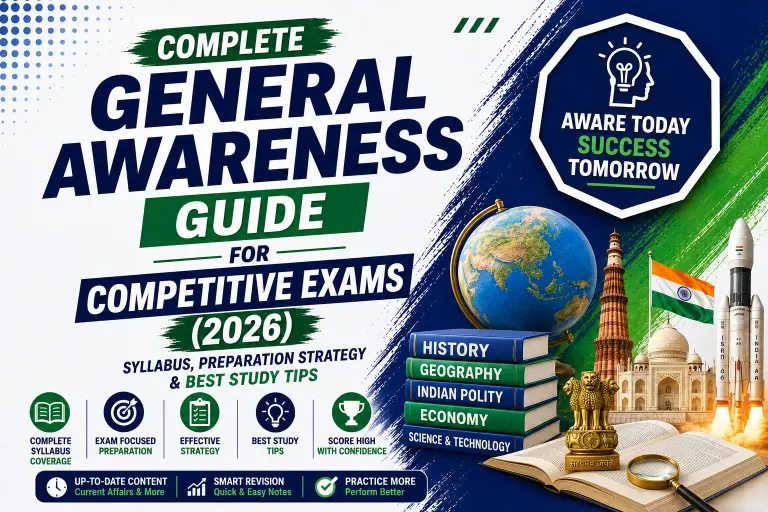
Complete General Awareness Guide for Competitive Exams (2026): Syllabus, Preparation Strategy & Best Study Tips
General Awareness (GA) is one of the most important sections in almost every competitive examination in India. Whether you're preparing for SSC CGL, SSC CHSL, SSC MTS, IBPS PO, IBPS Clerk, SBI PO, SBI Clerk, RBI Assistant, RRB NTPC, UPSC, CDS, NDA, State PSC, Defence, Insurance, or other government exams, a strong command of General Awareness can significantly improve your overall score.
Unlike Quantitative Aptitude or Reasoning Ability, General Awareness requires a combination of conceptual knowledge, current affairs, and regular revision. The good news is that this section can often be completed quickly during the exam because it usually doesn't involve lengthy calculations.
In this comprehensive guide, you'll learn everything about General Awareness, including the syllabus, important topics, preparation strategy, study resources, common mistakes, and expert tips to help you score high in competitive exams.
What Is General Awareness?
General Awareness refers to your knowledge of important facts, events, concepts, and developments happening around you. It includes both static knowledge (which rarely changes) and current affairs (which change regularly).
This section tests your awareness of:
- India and the World
- History
- Geography
- Indian Polity
- Economy
- Science
- Current Affairs
- Government Schemes
- Sports
- Awards
- Books and Authors
- International Organizations
- Important Days
A well-prepared candidate can score highly in this section with consistent study and revision.
Why Is General Awareness Important?
General Awareness is one of the highest-scoring sections because:
- It requires no lengthy calculations.
- Questions can usually be answered in a few seconds.
- It improves your overall exam score.
- It helps clear sectional cut-offs in many exams.
- It is common across multiple competitive exams.
Strong preparation in GA also helps during interviews and group discussions for certain recruitment processes.
General Awareness Syllabus
Although the exact syllabus varies by exam, most government exams cover the following topics.
Indian History
History questions often focus on important events, rulers, movements, and personalities.
Important areas include:
- Ancient India
- Medieval India
- Modern India
- Indian Freedom Movement
- Revolts against British Rule
- Important Freedom Fighters
- Constitutional Development
Indian Geography
Geography questions test your understanding of India's physical and political features.
Focus on:
- Mountains
- Rivers
- Plateaus
- Deserts
- Climate
- Soil Types
- Agriculture
- National Parks
- Wildlife Sanctuaries
- States and Capitals
Maps are particularly helpful for learning geography.
Indian Polity
Polity is one of the most important sections for competitive exams.
Key topics include:
- Constitution of India
- Preamble
- Fundamental Rights
- Fundamental Duties
- Directive Principles
- Parliament
- President
- Prime Minister
- Supreme Court
- High Courts
- Election Commission
- Constitutional Amendments
Understanding concepts is more useful than memorizing isolated facts.
Indian Economy
Economy questions usually test basic economic concepts rather than advanced theories.
Important topics include:
- GDP
- Inflation
- RBI
- Monetary Policy
- Budget
- Banking System
- Taxation
- Financial Institutions
- Digital Payments
- Economic Surveys
These topics are especially important for Banking and Insurance exams.
General Science
Science questions are usually based on school-level concepts.
The syllabus covers:
- Physics
- Chemistry
- Biology
- Human Body
- Environment
- Space Science
- Scientific Discoveries
Focus on understanding basic concepts instead of advanced technical details.
Current Affairs
Current Affairs are essential for almost every competitive exam.
Important areas include:
- National News
- International News
- Government Schemes
- Economy
- Science & Technology
- Sports
- Awards
- Appointments
- Defence
- Environment
Reading current affairs daily is the best preparation strategy.
Static General Knowledge
Static GK includes facts that rarely change.
Topics include:
- National Symbols
- Important Days
- Books and Authors
- Capitals
- Currencies
- Dams
- Lakes
- Airports
- International Organizations
- UNESCO World Heritage Sites
These topics frequently appear in SSC and Railway exams.
How to Prepare for General Awareness
Many students struggle because they try to memorize everything. A smarter approach is to build your knowledge gradually.
Step 1: Understand the Syllabus
Before starting, review the official syllabus of your target exam.
This helps you focus on relevant topics instead of studying unnecessary material.
Step 2: Build Strong Fundamentals
Start with static subjects such as:
- History
- Geography
- Polity
- Economy
- Science
Understanding these basics makes current affairs easier to follow.
Step 3: Read Current Affairs Daily
Spend 20–30 minutes every day reading reliable current affairs.
Focus on:
- Government initiatives
- Important appointments
- National events
- International developments
- Sports achievements
- Science and technology updates
Consistency is more effective than reading everything at the end of the month.
Step 4: Make Short Notes
Create concise notes covering:
- Important dates
- Awards
- Government schemes
- Constitutional articles
- Scientific facts
- Economic terms
These notes are invaluable during revision.
Step 5: Revise Regularly
Revision is the key to retaining information.
A simple revision plan:
- Daily revision of current affairs
- Weekly revision of static GK
- Monthly revision of all completed topics
Repeated revision strengthens long-term memory.
Best Daily Study Plan
A balanced routine can help you cover the syllabus effectively.
30 Minutes
Read current affairs.
45 Minutes
Study one static subject such as History or Polity.
30 Minutes
Solve General Awareness practice questions.
15 Minutes
Revise short notes.
Studying consistently for 1.5–2 hours daily can significantly improve your General Awareness over time.
Common Mistakes Students Make
Many aspirants lose marks because they:
- Ignore current affairs.
- Skip revision.
- Memorize facts without understanding concepts.
- Avoid practicing MCQs.
- Study from too many sources.
- Neglect static GK.
- Start current affairs only a few weeks before the exam.
Avoiding these mistakes can improve both your confidence and your score.
Tips to Score High in General Awareness
- Read newspapers or reliable current affairs sources daily.
- Focus on understanding rather than rote memorization.
- Practice topic-wise MCQs regularly.
- Revise important facts every week.
- Solve previous year question papers.
- Attempt sectional mock tests.
- Keep your study sources limited and reliable.
Consistency matters more than studying for long hours occasionally.
Importance of Previous Year Questions
Previous year papers help you:
- Identify frequently asked topics.
- Understand the exam pattern.
- Learn the difficulty level.
- Improve confidence.
- Practice under exam conditions.
Analyzing previous questions also helps you prioritize high-weightage topics.
Frequently Asked Questions (FAQs)
What is General Awareness in competitive exams?
General Awareness is a section that tests your knowledge of current affairs, history, geography, polity, economy, science, static GK, and important national and international events.
How much time should I study General Awareness daily?
Spending 1.5 to 2 hours daily, including current affairs, revision, and practice questions, is usually sufficient for steady improvement.
Is Current Affairs more important than Static GK?
Both are equally important. Current Affairs cover recent events, while Static GK provides the foundation needed for many competitive exams.
How can I remember General Awareness topics?
Make short notes, revise regularly, solve MCQs, and relate new information to concepts you've already learned. Frequent revision is the best way to improve retention.
Are previous year questions enough for General Awareness preparation?
Previous year questions are highly valuable, but they should be combined with regular current affairs reading, static GK study, and mock tests for comprehensive preparation.
Conclusion
General Awareness is one of the most rewarding sections in competitive exams because it combines knowledge with speed. A well-prepared candidate can answer many questions in seconds, saving valuable time for other sections. Success in this subject comes from building strong fundamentals, staying updated with current affairs, practicing regularly, and revising consistently.
Rather than trying to memorize everything at once, focus on understanding concepts, maintaining concise notes, and following a disciplined study routine. With consistent effort and smart preparation, you can turn General Awareness into one of your strongest scoring areas and significantly improve your chances of clearing your dream competitive exam.