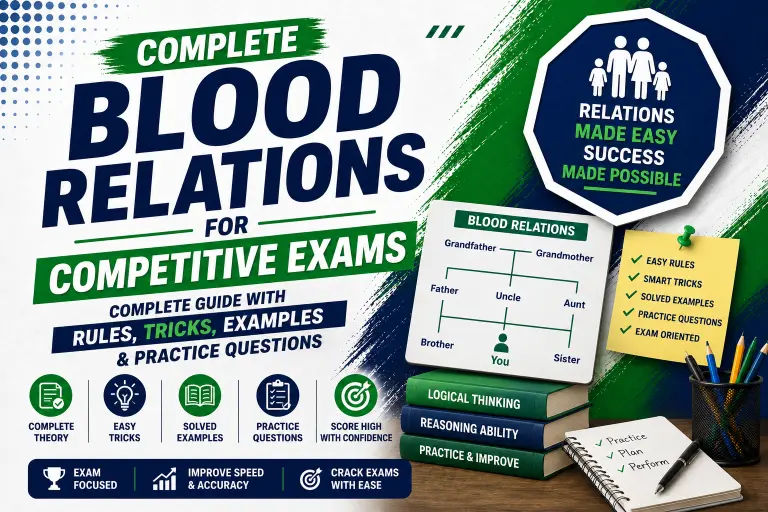
Blood Relations for Competitive Exams: Complete Guide with Rules, Tricks, Examples & Practice Questions
Blood Relations is one of the easiest and most scoring topics in the Reasoning Ability section of competitive exams. Questions from this topic are regularly asked in SSC CGL, SSC CHSL, SSC MTS, CPO, IBPS PO, SBI PO, IBPS Clerk, RBI Assistant, RRB NTPC, CDS, NDA, State PSC, Insurance Exams, and other government recruitment examinations.
Although Blood Relation questions may seem confusing initially, they become straightforward once you understand family relationships and learn a systematic solving approach. Most questions can be solved within 30–60 seconds with regular practice.
In this complete guide, you'll learn the types of Blood Relation questions, important family terms, solving tricks, shortcuts, examples, common mistakes, and practice questions.
What Are Blood Relation Questions?
Blood Relation questions test your ability to identify relationships between different family members based on the information provided.
These questions evaluate:
- Logical thinking
- Analytical reasoning
- Observation skills
- Problem-solving ability
- Decision-making
Instead of testing your memory, they assess how well you can interpret family relationships.
Why Blood Relations Are Important
Blood Relation questions appear frequently because they are easy to evaluate and require logical reasoning rather than calculations.
Mastering this topic helps you:
- Improve your reasoning score.
- Increase question-solving speed.
- Build confidence.
- Save time for difficult reasoning questions.
Since most exams ask at least one or two Blood Relation questions, preparing this topic can earn you quick marks.
Basic Family Relationships You Must Know
Before solving questions, you should understand common family terms.
Male Relations
- Father
- Son
- Brother
- Grandfather
- Grandson
- Uncle
- Nephew
- Father-in-law
Female Relations
- Mother
- Daughter
- Sister
- Grandmother
- Granddaughter
- Aunt
- Niece
- Mother-in-law
Learning these relationships forms the foundation of solving Blood Relation problems.
Important Family Tree
A simple family tree makes relationships easier to understand.
          Grandfather ── Grandmother
                  │
        -----------------------
        │                     │
     Father ── Mother      Uncle ── Aunt
        │
  --------------------
  │                  │
Son                Daughter
Drawing a rough family tree during the exam can simplify even complex questions.
Types of Blood Relation Questions
Most competitive exams include one or more of the following types:
- Direct Blood Relation
- Puzzle-Based Blood Relation
- Coded Blood Relation
- Pointing Method
- Family Tree Questions
- Mixed Logical Relations
Understanding each type improves your overall preparation.
Type 1: Direct Blood Relation
These questions directly describe relationships.
Example
Ravi is the son of Mohan.
Mohan is the father of Neha.
How is Ravi related to Neha?
Answer
Brother
These questions are usually straightforward.
Type 2: Pointing Method
In this type, a person points to someone and describes their relationship.
Example
A man says,
"She is the daughter of my father's only son."
Who is she?
Since "my father's only son" refers to the speaker himself,
the girl is his daughter.
Always identify the speaker first before solving.
Type 3: Puzzle-Based Blood Relation
These questions provide multiple relationships.
Example
A is the father of B.
B is the sister of C.
C is married to D.
What is D's relationship with A?
Answer
Son-in-law
Write each relationship step by step to avoid confusion.
Type 4: Coded Blood Relation
Special symbols represent family relationships.
Example:
- means Father
- – means Mother
- × means Brother
- ÷ means Sister
Candidates must decode the symbols before answering.
These questions require careful reading of the coding instructions.
Type 5: Family Tree Questions
A family tree is provided, and candidates answer questions based on it.
Example questions include:
- Who is the maternal uncle?
- Who is the granddaughter?
- Who is the elder brother?
Family tree questions become easy if you analyze relationships systematically.
Tricks to Solve Blood Relation Questions
Draw a Family Tree
The easiest way to solve Blood Relation questions is by drawing a simple diagram.
Visual representation reduces confusion and minimizes mistakes.
Identify the Speaker
In pointing questions, determine who is speaking before analyzing relationships.
Many students make mistakes because they ignore this step.
Solve Step by Step
Never attempt to solve complex questions mentally.
Write every relationship separately.
This approach reduces errors.
Understand Gender Clearly
Always identify whether the person is male or female.
Words like:
- Son
- Brother
- Uncle
indicate male relations.
Words like:
- Daughter
- Sister
- Aunt
indicate female relations.
Incorrect gender identification often leads to wrong answers.
Common Blood Relation Terms
Relation | Meaning |
|---|---|
Uncle | Father's or Mother's Brother |
Aunt | Father's or Mother's Sister |
Nephew | Brother's or Sister's Son |
Niece | Brother's or Sister's Daughter |
Cousin | Uncle's or Aunt's Child |
Father-in-law | Spouse's Father |
Mother-in-law | Spouse's Mother |
Brother-in-law | Sister's Husband or Spouse's Brother |
Memorizing these terms helps solve questions faster.
Practice Questions
Question 1
Rita is the daughter of Mohan.
Mohan is the father of Rahul.
How is Rita related to Rahul?
Answer
Sister
Question 2
A woman says,
"He is the son of my mother's only son."
Who is he?
Answer
Her son
Question 3
If
A is the brother of B,
B is the mother of C,
How is A related to C?
Answer
Maternal Uncle
Question 4
Pointing toward a boy, Ravi says,
"He is the son of my grandfather's only son."
Who is the boy?
Answer
Ravi's brother (or Ravi himself, depending on the exact wording and options).
Question 5
P is the father of Q.
Q is married to R.
R is the mother of S.
How is P related to S?
Answer
Grandfather
Common Mistakes Students Make
Many aspirants lose easy marks because they:
- Solve mentally instead of drawing diagrams.
- Ignore the speaker.
- Misidentify gender.
- Read the question too quickly.
- Skip one relationship while analyzing.
- Assume relationships without verifying them.
A simple family tree can prevent most of these mistakes.
Daily Practice Strategy
To master Blood Relations:
15 Minutes
Revise family relationships.
20 Minutes
Solve 20 Blood Relation questions.
15 Minutes
Review incorrect answers.
20 Minutes
Practice mixed reasoning questions.
Regular practice helps you recognize patterns quickly.
Exam Tips
- Read every statement carefully.
- Underline relationship words.
- Draw a family tree whenever needed.
- Don't assume missing information.
- Eliminate incorrect options logically.
- Skip lengthy questions initially if you're unsure.
Accuracy is more important than speed.
Frequently Asked Questions (FAQs)
Is Blood Relation an important topic for competitive exams?
Yes. Blood Relation questions are commonly asked in SSC, Banking, Railway, Defence, Insurance, and State-level competitive exams.
What is the easiest way to solve Blood Relation questions?
Drawing a simple family tree is the most effective method. It helps visualize relationships and reduces confusion.
How many Blood Relation questions are asked in exams?
The number varies depending on the exam, but candidates can usually expect one to three questions directly or indirectly based on Blood Relations.
Can I master Blood Relations without coaching?
Absolutely. With regular practice, understanding of family relationships, and solving previous year questions, most candidates can master this topic independently.
How much time should I spend practicing Blood Relations?
Practicing for 20–30 minutes daily is sufficient to develop speed and confidence.
Conclusion
Blood Relations is one of the easiest scoring topics in the Reasoning Ability section when approached systematically. Instead of trying to solve questions mentally, use diagrams, identify the speaker, and analyze each relationship step by step.
With consistent practice, you'll be able to solve Blood Relation questions accurately within seconds. Since this topic appears regularly in competitive exams, investing time in mastering it can significantly improve your reasoning score and overall exam performance.