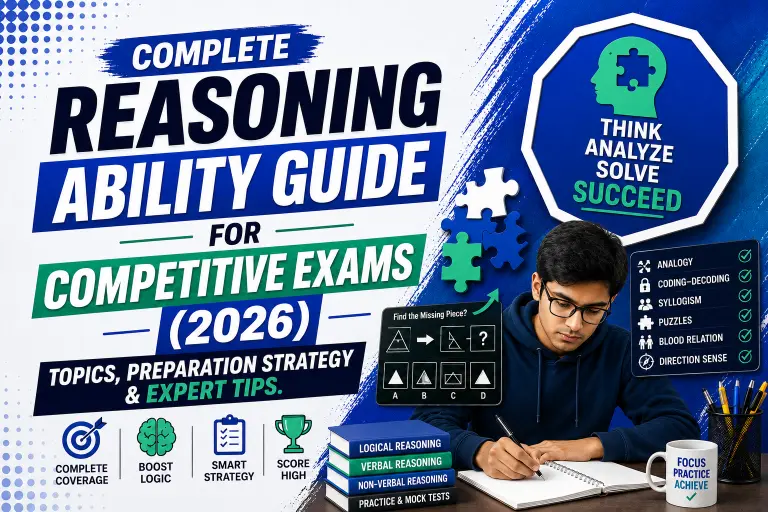
Complete Reasoning Ability Guide for Competitive Exams (2026): Topics, Preparation Strategy & Expert Tips
Reasoning Ability is one of the most scoring sections in competitive exams. Whether you're preparing for SSC CGL, SSC CHSL, IBPS PO, SBI PO, IBPS Clerk, RBI Assistant, RRB NTPC, CDS, NDA, State PSC, or other government exams, reasoning plays a crucial role in improving your overall score.
Unlike subjects that rely heavily on memorization, Reasoning Ability tests your logical thinking, analytical skills, decision-making, and problem-solving abilities. The best part is that once you understand the concepts and practice consistently, you can solve reasoning questions quickly and accurately.
In this comprehensive guide, we'll cover everything you need to know about Reasoning Ability, including important topics, preparation strategies, common mistakes, and practical tips to help you score high in competitive exams.
What Is Reasoning Ability?
Reasoning Ability evaluates your capacity to think logically and solve problems based on patterns, relationships, and analytical thinking rather than factual knowledge.
The questions are designed to assess:
- Logical thinking
- Analytical skills
- Observation
- Decision-making
- Pattern recognition
- Problem-solving speed
Since there are no lengthy theories to memorize, reasoning is considered one of the highest-scoring sections with regular practice.
Why Reasoning Is Important in Competitive Exams
Most competitive exams allocate 20–40 questions to the Reasoning section.
A strong performance in reasoning can:
- Improve your overall score.
- Increase your speed during the exam.
- Help clear sectional cut-offs.
- Boost confidence for other sections.
Candidates who practice reasoning regularly often complete this section faster than Quantitative Aptitude, allowing more time for difficult questions.
Major Topics in Reasoning Ability
Most competitive exams include questions from the following topics:
- Analogy
- Classification (Odd One Out)
- Coding-Decoding
- Blood Relations
- Direction Sense
- Alphabet Series
- Number Series
- Seating Arrangement
- Puzzles
- Syllogism
- Inequalities
- Statement and Conclusion
- Statement and Assumption
- Ranking and Order
- Data Sufficiency
- Input-Output (Banking Exams)
Mastering these topics builds a solid foundation for almost every government exam.
How to Start Preparing for Reasoning
Beginners often feel overwhelmed by the variety of question types. The best approach is to start with simpler topics before moving to complex puzzles.
A suggested order is:
- Analogy
- Classification
- Alphabet Series
- Number Series
- Coding-Decoding
- Blood Relations
- Direction Sense
- Ranking
- Syllogism
- Inequalities
- Seating Arrangement
- Puzzles
This progression helps develop logical thinking step by step.
Topic-Wise Preparation Strategy
Analogy
Analogy questions test the relationship between two words, numbers, or figures.
Example:
Book : Reading :: Pen : ?
Answer: Writing
Focus on identifying logical relationships instead of memorizing patterns.
Classification (Odd One Out)
In these questions, you must identify the item that does not belong to the group.
Example:
- Apple
- Mango
- Banana
- Car
Answer: Car
Practice improves your ability to recognize categories quickly.
Coding-Decoding
Coding-Decoding questions involve identifying patterns used to encode words, letters, or numbers.
Common types include:
- Letter Coding
- Number Coding
- Symbol Coding
- Mixed Coding
Regular practice is the key to solving these quickly.
Blood Relations
Blood Relation questions test family relationships.
Learn terms such as:
- Father
- Mother
- Brother
- Sister
- Uncle
- Aunt
- Cousin
- Grandfather
Drawing a simple family tree often makes these questions easier.
Direction Sense
Direction questions involve movement and orientation.
Understand:
- North
- South
- East
- West
- Left and Right turns
- Clockwise and Anti-clockwise movement
Practice drawing rough diagrams while solving questions.
Seating Arrangement
Seating Arrangement is one of the most important topics in Banking exams and is also asked in several SSC and insurance exams.
Common types include:
- Linear Arrangement
- Circular Arrangement
- Square Arrangement
- Rectangular Arrangement
Start with basic arrangements before attempting complex puzzles.
Puzzles
Puzzle questions combine multiple logical conditions.
Common puzzle types include:
- Floor Puzzle
- Box Puzzle
- Scheduling Puzzle
- Month Puzzle
- Day-Based Puzzle
Initially, these questions may seem lengthy, but consistent practice significantly improves solving speed.
Syllogism
Syllogism questions test logical conclusions based on given statements.
Example:
All cats are animals.
Some animals are pets.
Conclusion?
Learning Venn Diagram techniques makes syllogisms much easier.
Inequalities
Candidates compare relationships using symbols such as:
- <
- ≥
- ≤
- =
Practice helps you identify valid conclusions quickly.
Daily Practice Routine
A structured routine leads to steady improvement.
20 Minutes
Revise concepts from one reasoning topic.
40 Minutes
Solve topic-wise practice questions.
30 Minutes
Attempt one sectional reasoning test.
20 Minutes
Review mistakes and understand the correct approach.
10 Minutes
Revise shortcuts and notes.
Practicing daily is more effective than studying for long hours occasionally.
Importance of Mock Tests
Mock tests help you:
- Improve speed.
- Increase accuracy.
- Manage time effectively.
- Identify weak topics.
- Build confidence.
Always analyze your performance after every mock instead of simply checking your score.
Common Mistakes Students Make
Many aspirants lose marks due to avoidable errors.
Common mistakes include:
- Jumping directly to difficult puzzles.
- Ignoring basic concepts.
- Spending too much time on one question.
- Not practicing regularly.
- Avoiding mock tests.
- Failing to analyze mistakes.
- Guessing answers without logical reasoning.
Avoiding these mistakes can significantly improve your score.
Best Preparation Tips
- Practice every day.
- Start with easy topics.
- Maintain a notebook of mistakes.
- Solve previous year questions.
- Attempt sectional mocks regularly.
- Learn shortcut techniques after understanding the concepts.
- Increase difficulty gradually.
Consistency is more important than solving hundreds of questions in a single day.
Frequently Asked Questions (FAQs)
Is Reasoning Ability difficult?
No. Reasoning is based on logic rather than memorization. With regular practice, most candidates see significant improvement.
Which reasoning topic is the easiest?
Analogy, Classification, Alphabet Series, and Direction Sense are generally considered beginner-friendly topics.
How much time should I spend on reasoning daily?
Practicing for 60–90 minutes every day is usually sufficient to build speed and accuracy.
Are puzzles important for competitive exams?
Yes. Puzzles are especially important for Banking and Insurance exams and are also asked in some other government recruitment tests.
Can I improve reasoning without coaching?
Absolutely. With quality study material, previous year questions, mock tests, and consistent practice, many aspirants prepare successfully on their own.
Conclusion
Reasoning Ability is one of the most rewarding sections in competitive exams because it depends more on logical thinking than memorization. By building a strong foundation, practicing topic-wise questions, and taking regular mock tests, you can significantly improve your speed and accuracy.
Success in reasoning comes from consistency. Spend time every day solving different question types, review your mistakes, and gradually increase the difficulty level. Over time, you'll develop the confidence and problem-solving skills needed to excel in any competitive examination.