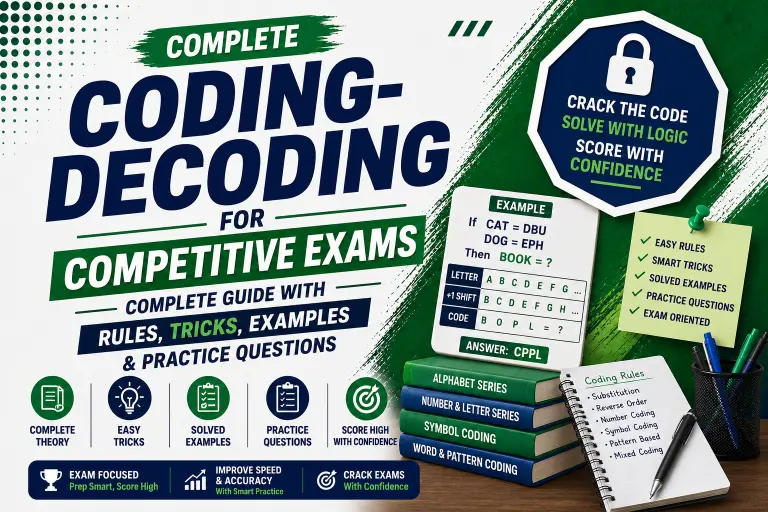
Coding-Decoding for Competitive Exams: Complete Guide with Rules, Tricks, Examples & Practice Questions
Coding-Decoding is one of the most important and scoring topics in the Reasoning Ability section of competitive exams. Questions from this topic are frequently asked in SSC CGL, SSC CHSL, SSC MTS, IBPS PO, SBI PO, IBPS Clerk, RBI Assistant, RRB NTPC, CDS, NDA, State PSC, Insurance Exams, and other government recruitment tests.
Many candidates find Coding-Decoding confusing at first because every question follows a different pattern. However, once you understand the common coding techniques and practice regularly, this topic becomes one of the easiest to score.
In this comprehensive guide, you'll learn the different types of Coding-Decoding questions, solving techniques, shortcuts, common mistakes, and practice questions to help you prepare effectively.
What Is Coding-Decoding?
Coding-Decoding is a logical reasoning topic where words, letters, numbers, or symbols are transformed according to a specific rule or pattern. Your task is to identify that rule and apply it to solve the given question.
These questions test:
- Logical thinking
- Pattern recognition
- Observation skills
- Analytical ability
- Accuracy under time pressure
Since every question follows a hidden rule, careful observation is the key to solving them.
Why Coding-Decoding Is Important
Coding-Decoding appears regularly in many competitive exams because it evaluates a candidate's reasoning ability rather than memorized knowledge.
Mastering this topic helps you:
- Improve your reasoning score.
- Increase solving speed.
- Build logical thinking skills.
- Gain confidence in other reasoning topics.
With regular practice, most Coding-Decoding questions can be solved in less than a minute.
Types of Coding-Decoding Questions
Different exams may include different styles of coding. The most common types are:
- Letter Coding
- Number Coding
- Symbol Coding
- Word Coding
- Sentence Coding
- Matrix Coding
- Substitution Coding
- Mixed Coding
Understanding each type prepares you for a variety of exam questions.
Type 1: Letter Coding
In Letter Coding, each letter is replaced according to a specific rule.
Example
If:
CAT → DBU
Then:
DOG → ?
Observe the pattern:
- C → D (+1)
- A → B (+1)
- T → U (+1)
Therefore:
DOG → EPH
The first step is always to identify the relationship between corresponding letters.
Type 2: Number Coding
In Number Coding, letters are represented by numbers.
Example:
A = 1
B = 2
C = 3
...
Z = 26
Example
If:
DOG = 4 + 15 + 7 = 26
Then:
CAT = ?
C = 3
A = 1
T = 20
Total = 24
Many exams use alphabetical positions as the basis for number coding.
Type 3: Symbol Coding
Letters or words are replaced with symbols.
Example:
A → #
B → $
C → %
D → &
Questions require you to identify the correct symbol sequence based on the coding rule.
Type 4: Word Coding
Entire words are assigned different meanings.
Example:
If
- Apple means Mango
- Mango means Orange
- Orange means Banana
Then answer questions based on the new meanings rather than the actual words.
These questions test careful reading and logical interpretation.
Type 5: Sentence Coding
Sentence Coding provides coded versions of complete sentences.
Example:
"Ram is intelligent"
→ pa la ko
"Shyam is honest"
→ la nu fi
From the common word "is," you can identify its corresponding code.
These questions require comparing multiple coded statements.
Type 6: Mixed Coding
Mixed Coding combines letters, numbers, and symbols.
Example:
A → 5
B → #
C → 9
Questions may involve multiple transformations, making careful observation essential.
Important Tricks to Solve Coding-Decoding Questions
Look for Alphabet Patterns
Many questions involve shifting letters forward or backward.
Examples:
+1
+2
-1
-2
Knowing alphabetical positions speeds up calculations.
Memorize Alphabet Positions
Learning the positions of letters significantly reduces solving time.
Examples:
A = 1
E = 5
J = 10
M = 13
R = 18
Z = 26
This eliminates the need to count letters repeatedly.
Observe Repetition
Repeated words or letters often reveal the coding rule.
If the same word appears in multiple coded sentences, its code is usually the repeated symbol or word.
Break Long Questions into Smaller Parts
Instead of analyzing an entire coded sentence at once:
- Identify common words.
- Match repeated codes.
- Eliminate possibilities one by one.
This approach simplifies complex questions.
Common Coding Patterns
Frequently used patterns include:
- Alphabet Forward Shift
- Alphabet Backward Shift
- Reverse Alphabet Order
- Alternate Letter Coding
- Letter Position Addition
- Letter Position Subtraction
- Odd-Even Position Changes
- Word Rearrangement
- Symbol Replacement
Practicing different patterns helps you recognize them more quickly during exams.
Common Mistakes Students Make
Many aspirants lose marks because they:
- Rush without identifying the pattern.
- Ignore alphabetical positions.
- Misread symbols.
- Skip repeated words.
- Assume the rule too early.
- Fail to verify their answer.
Always confirm the pattern before choosing an option.
Preparation Strategy
To master Coding-Decoding:
Step 1
Understand the basic coding techniques.
Step 2
Practice one coding type at a time.
Step 3
Solve previous year questions.
Step 4
Attempt sectional reasoning tests.
Step 5
Analyze incorrect answers.
Consistent practice is the key to improving both speed and accuracy.
Practice Questions
Question 1
If
BOOK → CPPL
Then
PEN → ?
Answer
QFO
Question 2
If
A = 1
B = 2
...
Z = 26
Find the value of:
CODE
C = 3
O = 15
D = 4
E = 5
Total = 27
Question 3
If
SUN → TVO
Then
CAR → ?
Answer
DBS
Question 4
If
CAT = 24
DOG = 26
Find:
BAT
Using alphabetical positions:
B = 2
A = 1
T = 20
Total = 23
Question 5
If
APPLE → BQQMF
Then
GRAPE → ?
Apply the same forward shift rule to each letter.
Daily Practice Plan
To improve consistently:
- 20 Coding-Decoding questions
- 15 Alphabet Series questions
- 10 Analogy questions
- 15 Classification questions
Spend at least 30–40 minutes daily practicing reasoning.
Tips for Exam Day
- Read the coding rule carefully.
- Don't assume the pattern immediately.
- Check all letters before finalizing.
- Skip lengthy questions initially.
- Return to difficult questions later.
- Avoid unnecessary calculations.
Smart question selection saves valuable time during the exam.
Frequently Asked Questions (FAQs)
Is Coding-Decoding difficult?
No. It becomes much easier once you understand common coding patterns and practice regularly.
Which exams ask Coding-Decoding questions?
Coding-Decoding is asked in SSC, Banking, Railway, Defence, Insurance, State PSC, and many other competitive exams.
How can I improve Coding-Decoding quickly?
Practice different coding types daily, memorize alphabetical positions, and solve previous year questions to recognize patterns faster.
How much time should I spend on this topic?
Practicing 20–30 minutes daily is enough to build confidence and improve speed over time.
Are previous year Coding-Decoding questions useful?
Yes. Previous year questions help you understand frequently used patterns and the level of difficulty expected in actual exams.
Conclusion
Coding-Decoding is one of the easiest reasoning topics to master with consistent practice and careful observation. By understanding common coding patterns, learning alphabetical positions, and solving a variety of questions, you can significantly improve your logical reasoning skills and exam performance.
Instead of memorizing tricks alone, focus on understanding the logic behind each coding rule. With daily practice and regular revision, you'll be able to solve Coding-Decoding questions quickly, accurately, and confidently in any competitive examination.