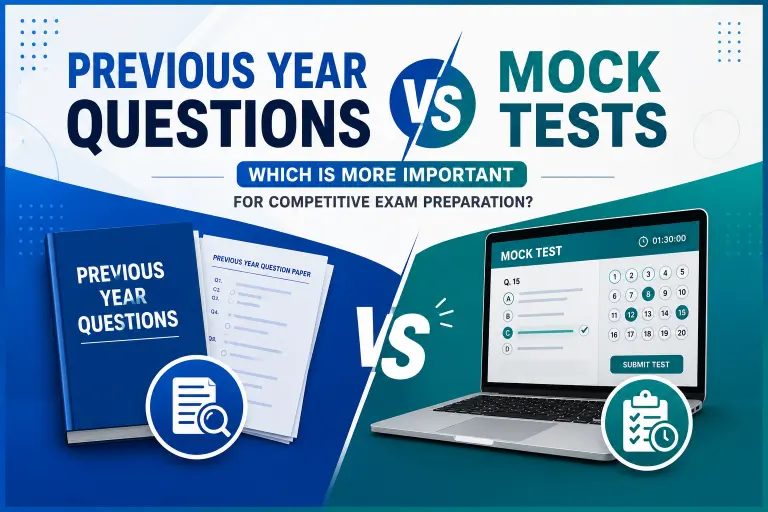
Previous Year Questions vs Mock Tests: Which Is More Important for Competitive Exam Preparation?
One of the most common questions asked by competitive exam aspirants is: Should I focus more on Previous Year Questions (PYQs) or Mock Tests? Whether you're preparing for SSC CGL, SSC CHSL, Banking Exams (IBPS, SBI, RBI), Railway Exams (RRB), UPSC, State PSC, Defence Exams, or other government recruitment tests, this dilemma often arises during preparation.
Both Previous Year Questions and Mock Tests are essential tools, but they serve different purposes. While PYQs help you understand the actual exam pattern and frequently asked concepts, mock tests simulate the real exam environment and improve speed, accuracy, and time management.
So, which one deserves more attention?
In this article, we'll compare Previous Year Questions and Mock Tests, explore their benefits, and explain how to use both effectively for maximum success.
What Are Previous Year Questions (PYQs)?
Previous Year Questions are the actual questions that appeared in earlier examinations. They provide a direct insight into how the exam is conducted and what type of questions are typically asked.
For most competitive exams, candidates can access papers from the last 5–10 years, making PYQs one of the most reliable study resources.
Benefits of Solving Previous Year Questions
1. Understand the Real Exam Pattern
The biggest advantage of PYQs is that they show you the actual structure of the exam.
You'll understand:
- Question types
- Difficulty level
- Section-wise weightage
- Frequently repeated concepts
- Important chapters
This allows you to prepare according to the exam rather than making assumptions.
2. Identify High-Weightage Topics
Competitive exams often repeat concepts, even if the questions are framed differently.
For example:
- SSC exams frequently ask questions from Percentage, Profit & Loss, Geometry, and Algebra.
- Banking exams regularly include Data Interpretation, Simplification, Number Series, and Arithmetic.
- Railway exams emphasize Arithmetic, General Science, and Current Affairs.
By solving PYQs, you can identify these patterns and prioritize your preparation.
3. Improve Conceptual Understanding
Unlike random practice questions, PYQs reflect the standard expected by the exam authorities.
When you analyze incorrect answers, you learn:
- Why you made the mistake
- Which concept needs revision
- Faster methods for solving similar questions
This strengthens your fundamentals over time.
4. Build Confidence
After solving several previous papers, candidates become familiar with the exam format.
This reduces fear of the unknown and boosts confidence before the actual exam.
What Are Mock Tests?
Mock Tests are simulated examinations designed to closely resemble the actual exam in terms of:
- Pattern
- Difficulty level
- Time limit
- Marking scheme
They help aspirants experience exam-like pressure before the real test.
Benefits of Taking Mock Tests
1. Improve Time Management
Many students know the concepts but fail to complete the paper within the allotted time.
Mock tests teach you:
- How much time to spend per question
- Which questions to skip
- When to move to the next section
- How to finish the paper efficiently
These skills can only be developed through regular timed practice.
2. Increase Speed and Accuracy
Competitive exams demand both speed and precision.
Frequent mock tests improve:
- Calculation speed
- Decision-making
- Reading speed
- Accuracy under pressure
Over time, candidates make fewer careless mistakes and solve questions more efficiently.
3. Simulate the Actual Exam Environment
One of the biggest advantages of mock tests is that they recreate real exam conditions.
You learn to handle:
- Time pressure
- Stress
- Negative marking
- Difficult questions
- Long exam durations
This experience helps you remain calm on exam day.
4. Measure Your Preparation
Mock tests provide valuable feedback.
You can evaluate:
- Overall score
- Section-wise performance
- Weak subjects
- Time taken
- Accuracy percentage
Regular analysis allows you to improve continuously.
Previous Year Questions vs Mock Tests: A Comparison
Feature | Previous Year Questions | Mock Tests |
|---|---|---|
Source | Actual Exam Papers | Practice Papers |
Purpose | Understand exam trends | Simulate real exam |
Difficulty | Actual exam level | Similar or slightly higher |
Time Management | Limited | Excellent |
Confidence Building | High | Very High |
Performance Analysis | Moderate | Detailed |
Speed Improvement | Moderate | Excellent |
Revision Tool | Excellent | Excellent |
Both resources are valuable, but they contribute in different ways.
When Should You Focus on Previous Year Questions?
PYQs are most useful during the early and middle stages of preparation.
At this stage, your goals should be to:
- Understand the syllabus
- Learn concepts
- Identify important topics
- Recognize question patterns
A recommended strategy is to solve chapter-wise PYQs immediately after completing each topic.
When Should You Focus on Mock Tests?
Mock tests become increasingly important as your preparation progresses.
Once you've covered a significant portion of the syllabus:
- Start sectional mock tests.
- Move to full-length mocks.
- Analyze every attempt.
- Track your improvement.
During the final month before the exam, mock tests should become a regular part of your preparation.
Which One Is More Important?
The truth is that neither Previous Year Questions nor Mock Tests alone are enough.
If you solve only PYQs:
- You may understand the exam pattern.
- But your speed and time management may remain weak.
If you attempt only mock tests:
- You may practice extensively.
- But you may miss recurring concepts and actual exam trends.
Success comes from combining both resources effectively.
The Ideal Preparation Strategy
A balanced approach works best.
Phase 1: Learn Concepts
- Study theory.
- Understand formulas.
- Solve basic questions.
Phase 2: Practice Previous Year Questions
After completing each topic:
- Solve chapter-wise PYQs.
- Review mistakes.
- Revise weak concepts.
Phase 3: Start Sectional Mock Tests
Focus on individual sections such as:
- Quantitative Aptitude
- Reasoning
- English
- General Awareness
Improve speed and accuracy in each section.
Phase 4: Attempt Full-Length Mock Tests
In the final weeks:
- Take 3–5 full mocks per week.
- Analyze every test carefully.
- Revise based on mistakes.
This combination ensures comprehensive preparation.
Common Mistakes Students Make
Avoid these common errors:
- Ignoring previous year papers completely.
- Taking mock tests without analyzing mistakes.
- Solving hundreds of questions without understanding concepts.
- Comparing mock scores with others.
- Practicing only favorite subjects.
- Avoiding difficult questions.
- Not revising after mock tests.
Learning from mistakes is more valuable than simply increasing the number of practice sessions.
Tips to Make the Best Use of Both
- Solve at least 5–10 years of previous papers.
- Attempt one sectional mock every week initially.
- Increase mock frequency as the exam approaches.
- Maintain an error notebook.
- Revise formulas regularly.
- Analyze incorrect answers thoroughly.
- Track your progress over time instead of focusing only on scores.
Frequently Asked Questions (FAQs)
Are Previous Year Questions enough to clear competitive exams?
No. PYQs are excellent for understanding the exam pattern and important topics, but they should be complemented with mock tests to improve speed, accuracy, and time management.
How many mock tests should I attempt before the exam?
Most aspirants benefit from attempting 20–40 quality mock tests, depending on the exam and preparation timeline.
Should beginners start with mock tests?
Beginners should first build a strong foundation by studying concepts and solving topic-wise Previous Year Questions. Mock tests can be introduced gradually after covering a substantial portion of the syllabus.
How many years of Previous Year Questions should I solve?
Ideally, solve papers from the last 5–10 years to understand recent trends and recurring question patterns.
What is more important in the last month before the exam?
During the final month, focus on a combination of revision, full-length mock tests, and selective Previous Year Question practice to strengthen weak areas and improve exam readiness.
Conclusion
The debate between Previous Year Questions and Mock Tests often leads students to believe they must choose one over the other. In reality, both are indispensable parts of a successful preparation strategy. Previous Year Questions help you understand what the exam demands, while Mock Tests train you to perform under those demands within the allotted time.
The smartest aspirants don't rely exclusively on either—they integrate both into a structured study plan. Begin by mastering concepts, reinforce them with Previous Year Questions, and gradually transition to regular mock tests as the exam approaches.
By balancing these two powerful preparation tools, you'll improve your knowledge, boost your confidence, sharpen your time management skills, and maximize your chances of clearing your competitive exam on the first attempt.