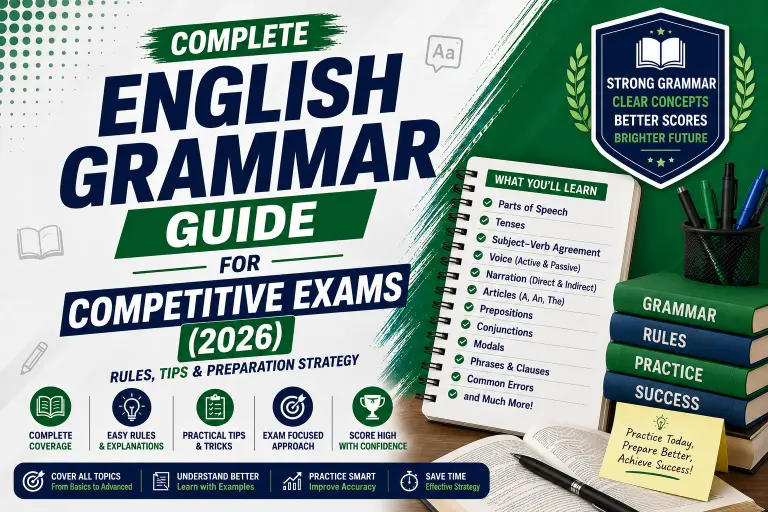
Complete English Grammar Guide for Competitive Exams (2026): Rules, Tips & Preparation Strategy
English is one of the highest-scoring sections in almost every competitive exam, including SSC CGL, SSC CHSL, SSC MTS, IBPS PO, IBPS Clerk, SBI PO, SBI Clerk, RBI Assistant, RRB NTPC, CDS, NDA, and many State Government Exams. Unlike subjects that require extensive calculations, the English section rewards candidates who have a strong understanding of grammar, vocabulary, and comprehension.
Many aspirants lose valuable marks because they memorize grammar rules without understanding how to apply them. The good news is that English is a skill that improves with consistent practice. By mastering the basics and following a structured preparation strategy, you can significantly improve your score.
This complete guide covers the essential grammar topics, preparation tips, common mistakes, and study strategies you need to excel in the English section of competitive exams.
Why English Is Important in Competitive Exams
The English section evaluates your ability to understand and use the language correctly. It tests grammar, vocabulary, sentence structure, comprehension, and logical understanding of written English.
A strong performance in English can:
- Increase your overall score.
- Improve your ranking.
- Help clear sectional cut-offs.
- Save time during the exam, as many English questions are quicker to solve than lengthy mathematical problems.
Since grammar rules remain largely the same across exams, learning them once benefits you in multiple competitive examinations.
Topics Covered in the English Section
Most government exams include questions from the following areas:
- Grammar
- Vocabulary
- Reading Comprehension
- Error Spotting
- Sentence Improvement
- Fill in the Blanks
- Cloze Test
- Para Jumbles
- Sentence Rearrangement
- Synonyms and Antonyms
- Idioms and Phrases
- One Word Substitution
Understanding these topics helps you plan your preparation effectively.
Essential Grammar Topics Every Aspirant Must Learn
1. Parts of Speech
Every sentence in English is built using eight parts of speech:
- Noun
- Pronoun
- Verb
- Adjective
- Adverb
- Preposition
- Conjunction
- Interjection
Learning these basics makes advanced grammar much easier to understand.
Example:
The hardworking student solved the difficult question quickly.
In this sentence:
- Student is a noun.
- Hardworking is an adjective.
- Solved is a verb.
- Quickly is an adverb.
2. Subject-Verb Agreement
The subject and verb must agree in number.
Correct:
- She writes every day.
- They play football.
Incorrect:
- She write every day.
- They plays football.
This topic is frequently tested through Error Spotting and Sentence Improvement questions.
3. Tenses
Tenses describe the time of an action.
The three primary categories are:
- Present Tense
- Past Tense
- Future Tense
Candidates should understand the structure and usage of all major tense forms.
Examples:
- I study every morning.
- I studied yesterday.
- I will study tomorrow.
4. Articles (A, An, The)
Articles seem simple but often confuse candidates.
General rules include:
- Use A before words beginning with a consonant sound.
- Use An before words beginning with a vowel sound.
- Use The for specific nouns.
Examples:
- A university
- An umbrella
- The Earth
5. Prepositions
Prepositions indicate relationships between words.
Common examples include:
- In
- On
- At
- Between
- Among
- Over
- Under
- Into
- Across
Questions often test the correct preposition in a sentence.
6. Active and Passive Voice
Competitive exams frequently include questions on changing sentences from active to passive voice.
Active:
The teacher explained the lesson.
Passive:
The lesson was explained by the teacher.
Understanding tense changes is important while converting sentences.
7. Direct and Indirect Speech
Reported speech is another commonly tested topic.
Direct Speech:
He said, "I am happy."
Indirect Speech:
He said that he was happy.
Practice reporting statements, questions, commands, and requests.
Vocabulary Preparation
A strong vocabulary improves performance in multiple sections.
Focus on:
- Synonyms
- Antonyms
- One Word Substitution
- Idioms and Phrases
- Phrasal Verbs
- Commonly Confused Words
Instead of memorizing hundreds of words in one day, learn 10–15 new words daily and revise them regularly.
Reading Comprehension
Reading Comprehension (RC) is one of the highest-scoring sections if approached correctly.
To improve:
- Read newspapers and editorials daily.
- Identify the central idea of each passage.
- Improve reading speed.
- Learn unfamiliar vocabulary from context.
- Practice answering inference-based questions.
Avoid guessing answers without reading the passage carefully.
Error Spotting
Error Spotting questions test your understanding of grammar rules.
Common error areas include:
- Subject-Verb Agreement
- Articles
- Tenses
- Pronouns
- Prepositions
- Conjunctions
- Parallelism
The best way to improve is by practicing questions daily and reviewing the grammar rule behind every mistake.
Sentence Improvement
In these questions, you need to identify the most grammatically correct version of a sentence.
Success depends on:
- Grammar knowledge
- Vocabulary
- Sentence structure
- Proper usage
Always read the entire sentence before selecting an option.
Para Jumbles
Para Jumbles require arranging sentences in the correct logical order.
Tips:
- Identify the introductory sentence.
- Look for connecting words.
- Follow the logical sequence of ideas.
- Find the concluding statement.
Practice improves your ability to recognize sentence flow.
Cloze Test
A Cloze Test consists of a passage with missing words.
To solve efficiently:
- Read the entire passage first.
- Understand the context.
- Consider grammar and vocabulary together.
- Avoid selecting words based only on individual blanks.
Context is often more important than memorizing vocabulary.
Common Grammar Mistakes Students Make
Many aspirants repeatedly make avoidable mistakes.
Some common ones include:
- Incorrect Subject-Verb Agreement
- Wrong tense usage
- Confusing "its" and "it's"
- Incorrect articles
- Misused prepositions
- Double negatives
- Wrong pronoun references
- Incorrect word order
Recognizing these mistakes helps improve both accuracy and confidence.
Best Daily English Practice Routine
A structured routine produces better results than random study.
20 Minutes
Revise grammar rules.
20 Minutes
Learn new vocabulary.
30 Minutes
Solve grammar practice questions.
20 Minutes
Read an English newspaper editorial or article.
30 Minutes
Practice Reading Comprehension or Error Spotting.
20 Minutes
Review mistakes and revise difficult concepts.
Even 2 hours of focused English practice daily can lead to noticeable improvement over a few months.
Preparation Tips for Competitive Exams
Follow these proven strategies:
- Study grammar before solving practice questions.
- Read English newspapers daily.
- Revise vocabulary regularly.
- Solve previous year English questions.
- Attempt sectional mock tests.
- Maintain an error notebook.
- Practice consistently instead of studying irregularly.
- Focus on understanding grammar rules rather than memorizing answers.
Best Books for English Preparation
Some widely recommended books include:
- Objective General English by S.P. Bakshi
- High School English Grammar and Composition by Wren & Martin
- Word Power Made Easy by Norman Lewis
- Plinth to Paramount by Neetu Singh
Use one grammar book consistently instead of switching between multiple resources.
Frequently Asked Questions (FAQs)
Is English difficult for competitive exams?
No. With regular practice and a strong understanding of grammar, English becomes one of the easiest scoring sections.
Which grammar topics are most important?
Subject-Verb Agreement, Tenses, Articles, Prepositions, Active-Passive Voice, Direct-Indirect Speech, and Error Spotting are among the most frequently tested topics.
How can I improve my English vocabulary?
Read newspapers daily, learn 10–15 new words each day, revise regularly, and practice using the words in sentences.
How much time should I dedicate to English every day?
Spending 1.5 to 2 hours daily on grammar, vocabulary, reading, and practice questions is sufficient for steady improvement.
Are previous year English questions important?
Yes. Previous year questions help you understand the exam pattern, identify frequently tested grammar concepts, and improve your confidence before the exam.
Conclusion
English is a scoring subject that can significantly improve your overall performance in competitive exams when prepared systematically. Instead of relying solely on memorization, focus on understanding grammar concepts, building vocabulary, and practicing regularly. A balanced approach that combines grammar study, reading comprehension, vocabulary development, and mock tests will help you perform with confidence on exam day.
Consistency is the key to success. By dedicating time every day to learning and revision, you'll strengthen your command of English and move closer to achieving your goal of clearing your desired competitive exam.