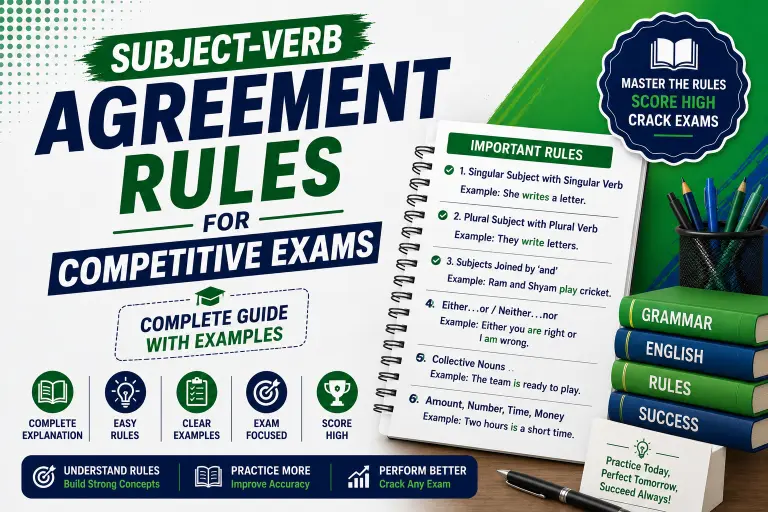
Subject-Verb Agreement Rules for Competitive Exams: Complete Guide with Examples
Subject-Verb Agreement is one of the most frequently tested grammar topics in competitive exams such as SSC CGL, SSC CHSL, SSC MTS, CPO, IBPS PO, SBI PO, IBPS Clerk, RBI Assistant, RRB NTPC, CDS, NDA, State PSC, and other government recruitment exams.
Questions based on Subject-Verb Agreement commonly appear in Error Spotting, Sentence Improvement, Fill in the Blanks, Cloze Tests, and Reading Comprehension. Although the rules seem simple, many aspirants lose marks because they overlook exceptions or get confused by sentence structure.
In this guide, you'll learn the most important Subject-Verb Agreement rules, common exceptions, examples, preparation tips, and practice questions to help you score better in the English section.
What Is Subject-Verb Agreement?
Subject-Verb Agreement means that the verb in a sentence must agree with its subject in number and person.
- A singular subject takes a singular verb.
- A plural subject takes a plural verb.
Examples
Correct
- The student studies every day.
- The students study every day.
Incorrect
- The student study every day.
- The students studies every day.
Understanding this basic principle is the first step toward mastering English grammar.
Why Subject-Verb Agreement Is Important
Competitive exams regularly test this concept because it reflects your understanding of sentence structure.
Mastering Subject-Verb Agreement helps you:
- Solve Error Spotting questions accurately.
- Improve Sentence Improvement performance.
- Answer Fill in the Blanks correctly.
- Avoid common grammatical mistakes.
- Increase your overall English score.
Rule 1: Singular Subject Takes a Singular Verb
When the subject is singular, the verb must also be singular.
Examples
- She writes neatly.
- The boy plays cricket.
- My father works in a bank.
Rule 2: Plural Subject Takes a Plural Verb
Plural subjects require plural verbs.
Examples
- The girls sing beautifully.
- The teachers explain the lesson.
- They work hard.
Rule 3: Two Subjects Joined by "And"
When two subjects are connected by and, they usually take a plural verb.
Examples
- Ram and Shyam are friends.
- Tea and coffee are available.
Exception
When two nouns refer to the same person or thing, use a singular verb.
Example
- The owner and manager is attending the meeting.
Here, both nouns refer to the same individual.
Rule 4: Subjects Joined by "Or" or "Nor"
When subjects are joined by or, nor, either...or, or neither...nor, the verb agrees with the subject closest to it.
Examples
- Either the teacher or the students are responsible.
- Either the students or the teacher is responsible.
- Neither the manager nor the employees were present.
Always focus on the subject nearest to the verb.
Rule 5: Indefinite Pronouns
Words such as:
- Everyone
- Everybody
- Someone
- Somebody
- Anyone
- Anybody
- Nobody
- Each
- Every
take singular verbs.
Examples
- Everyone is welcome.
- Each student has submitted the assignment.
- Somebody wants to meet you.
Rule 6: Collective Nouns
Collective nouns usually take singular verbs when the group acts as one unit.
Examples
- The team is playing well.
- The committee has announced the results.
- The family lives in Delhi.
Rule 7: Words Like "Each" and "Every"
When "each" or "every" comes before the subject, use a singular verb.
Examples
- Every student has a notebook.
- Each participant receives a certificate.
Rule 8: Uncountable Nouns
Uncountable nouns always take singular verbs.
Examples include:
- Information
- Advice
- Furniture
- Equipment
- Luggage
- Knowledge
Examples
- The information is useful.
- The furniture looks expensive.
Rule 9: Titles of Books, Movies, and Newspapers
Even though titles may appear plural, they usually take singular verbs.
Examples
- "The Chronicles of Narnia" is a popular book series.
- "The Times of India" is widely read.
Rule 10: Amounts of Money, Distance, and Time
When expressing a single unit, use a singular verb.
Examples
- Five thousand rupees is a large amount.
- Ten kilometers is too far to walk.
- Two hours is enough.
Rule 11: "One of the"
Use a singular verb after "one of the."
Example
- One of the students is absent.
Many candidates incorrectly use "are" here.
Rule 12: "The Number of" vs "A Number of"
These two expressions often confuse students.
The Number of
Takes a singular verb.
Example:
- The number of applicants has increased.
A Number of
Takes a plural verb.
Example:
- A number of students have qualified.
Rule 13: Nouns Ending in "S"
Some nouns ending with "s" are singular.
Examples:
- Mathematics
- Physics
- Economics
- Politics
Examples
- Mathematics is my favorite subject.
- Economics is interesting.
Rule 14: Either and Neither
Both "either" and "neither" are singular.
Examples
- Neither answer is correct.
- Either option works.
Rule 15: Relative Pronouns
The verb agrees with the noun referred to by the relative pronoun.
Example
- She is one of the students who work hard.
- She is the only student who works hard.
Pay close attention to the noun that "who" refers to.
Common Subject-Verb Agreement Errors
Many aspirants lose marks due to these mistakes:
❌ Everyone are happy.
✔ Everyone is happy.
❌ The information are useful.
✔ The information is useful.
❌ Neither the manager nor the employees is available.
✔ Neither the manager nor the employees are available.
❌ One of the boys are absent.
✔ One of the boys is absent.
❌ Mathematics are difficult.
✔ Mathematics is difficult.
Tips to Master Subject-Verb Agreement
- Always identify the subject first.
- Ignore extra phrases between the subject and verb.
- Learn common exceptions.
- Practice Error Spotting questions daily.
- Revise grammar rules weekly.
- Read English newspapers to observe correct sentence structures.
Regular practice strengthens your understanding and improves accuracy.
Practice Questions
Choose the correct verb.
1.
Each student _____ a notebook.
A. have
B. has
Answer: B
2.
Neither the teacher nor the students _____ ready.
A. is
B. are
Answer: B
3.
The committee _____ announced the decision.
A. has
B. have
Answer: A
4.
A number of candidates _____ selected.
A. has
B. have
Answer: B
5.
The number of applications _____ increasing.
A. is
B. are
Answer: A
Common Preparation Mistakes
Avoid these mistakes:
- Memorizing rules without understanding them.
- Ignoring exceptions.
- Practicing too few questions.
- Not reviewing incorrect answers.
- Confusing singular and plural nouns.
Understanding why an answer is correct is more important than simply memorizing it.
Frequently Asked Questions (FAQs)
Is Subject-Verb Agreement important for SSC and Banking exams?
Yes. It is one of the most frequently tested grammar topics and appears regularly in Error Spotting, Sentence Improvement, Cloze Tests, and Fill in the Blanks.
How can I improve Subject-Verb Agreement quickly?
Start by learning the core rules, then solve topic-wise practice questions daily and revise common exceptions every week.
Which rule confuses students the most?
Rules involving either...or, neither...nor, the number of, a number of, and indefinite pronouns are among the most confusing.
How many questions can be expected from this topic?
The number varies by exam, but Subject-Verb Agreement concepts often appear directly or indirectly in several English questions.
Is practicing previous year questions enough?
Previous year questions are very useful, but combining them with grammar exercises and mock tests provides better preparation.
Conclusion
Subject-Verb Agreement is one of the easiest grammar topics to master once you understand its rules and exceptions. Since it appears in almost every major competitive exam, investing time in this topic can significantly improve your English score. Focus on identifying the subject correctly, applying the appropriate verb, and practicing regularly through error spotting and sentence improvement exercises.
With consistent revision and daily practice, you'll develop the confidence to solve Subject-Verb Agreement questions quickly and accurately, giving you an edge in your competitive exam preparation.